Trial exhibit preparation is one of the most consequential responsibilities in litigation support. A mislabeled exhibit, incorrect exhibit number, or missing page discovered during testimony disrupts proceedings and creates unnecessary pressure on the legal team at the worst possible moment.
A reliable trial exhibit checklist — completed systematically before each trial — reduces the likelihood of those errors reaching the courtroom.
This guide walks through each phase and each checklist category in detail, including a practical example and a reference table for common trial preparation decisions.
What you'll learn
By the end of this guide you'll know how to:
- ✓ Structure exhibit preparation across three distinct pre-trial phases
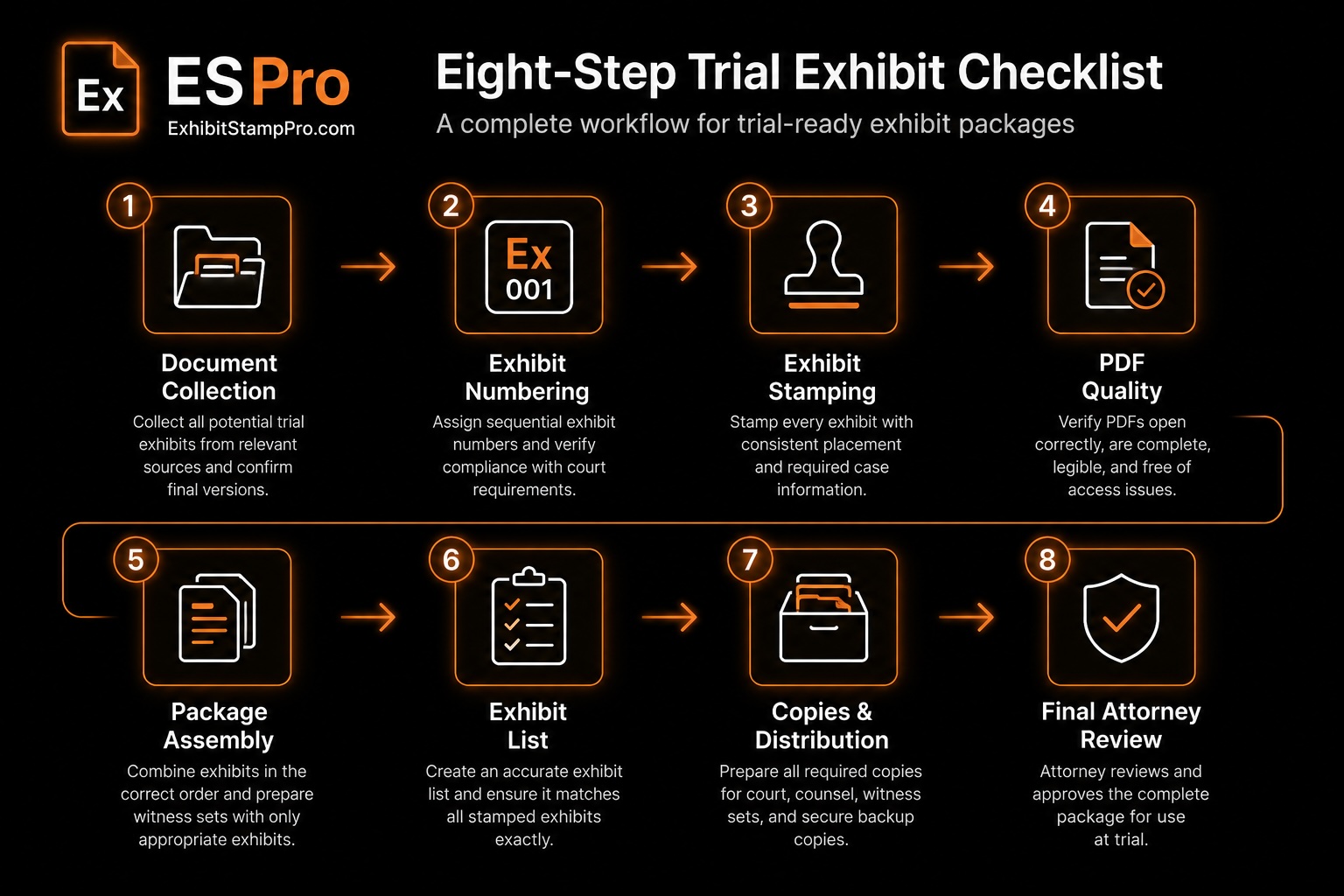
- ✓ Verify all eight exhibit checklist categories before trial
- ✓ Identify and resolve the most common last-minute problems
- ✓ Prepare exhibit packages for the court, judge, witnesses, and opposing counsel
- ✓ Conduct a final attorney review before the package is considered complete
This guide is written for litigation paralegals, legal assistants, litigation support specialists, junior associates, and trial preparation teams.
Why a trial exhibit checklist matters
Exhibit errors during trial are particularly disruptive because they occur in real time — in front of the judge, opposing counsel, and sometimes the jury. Unlike deposition errors, which can often be corrected before the record is finalized, trial exhibit problems may require immediate improvisation by the attorney.
Common consequences of inadequate exhibit preparation include:
- Exhibit numbers that do not match the exhibit list
- Witnesses unable to locate a document during testimony
- Missing pages discovered while a document is being referenced
- Duplicate exhibit numbers causing confusion about which document is being discussed
- Exhibits stamped incorrectly, with labels obscuring important content
- Copies missing for opposing counsel or the court
Systematic preparation — using a phase-based checklist — prevents most of these problems before they occur.
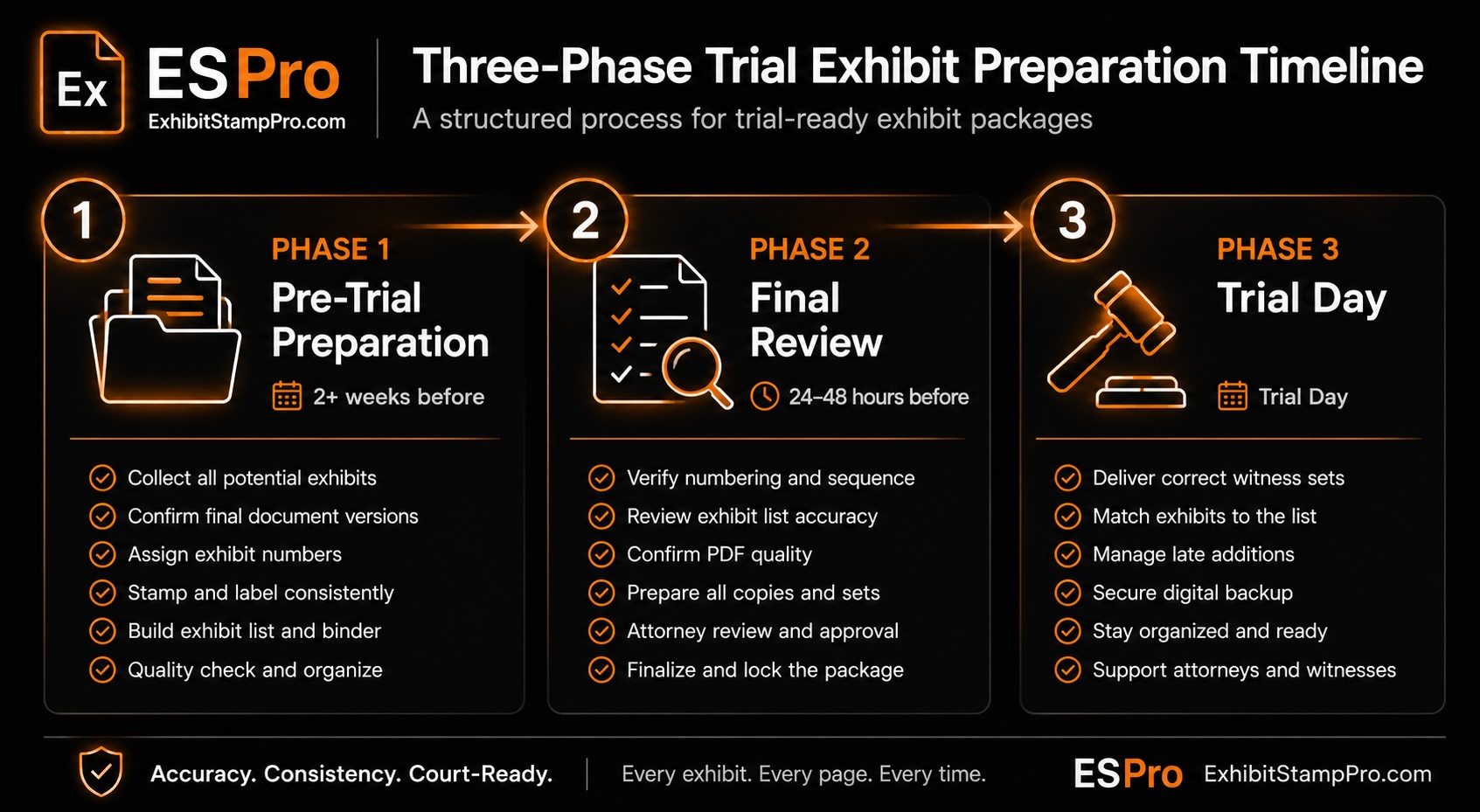
The three phases of trial exhibit preparation
Phase 1 — Pre-trial preparation (2+ weeks before trial)
The bulk of exhibit preparation should be completed well in advance of trial. Rushing this phase into the final days before proceedings creates unnecessary risk.
Document collection
- All potential trial exhibits collected from relevant sources
- Final document versions confirmed — not drafts or working copies
- Duplicate documents identified and removed
- Confidential or privileged materials reviewed for appropriate handling
- All file names follow office naming conventions
Exhibit numbering
- Numbering format confirmed with the responsible attorney
- Court requirements and local rules reviewed
- Prior deposition exhibit numbers checked (to avoid overlap or confirm continuation)
- Sequential numbers assigned — no gaps unless specifically instructed
- Exhibit numbers cross-checked against the exhibit list
Exhibit stamping
Every exhibit must be stamped before the package is assembled. Stamping after assembly forces the entire package to be rebuilt.
- Every exhibit stamped with its exhibit number
- Label placement consistent across all documents
- Case caption and relevant identifying information applied where required
- Confidentiality designations applied where appropriate
- No stamp obscures important document content
For larger trial packages, PDF exhibit stamping tools can apply labels consistently across hundreds of documents while preserving exact label placement.
Attorney review — Phase 1
- Draft exhibit list reviewed with attorney
- Exhibit order approved
- Numbering format confirmed
- Any required additions or removals completed
Phase 2 — Final review (24–48 hours before trial)
This is the highest-risk phase. Changes made at this stage can cascade through the entire package if not carefully controlled.
PDF quality
- Every PDF opens correctly and displays without errors
- All pages are legible and correctly oriented
- No pages are missing from multi-page documents
- Color documents remain in color where required
- File sizes are reasonable for any electronic submission requirements
- No password protection prevents access
Package assembly
- All exhibits combined in the correct order
- Exhibit binders or digital packages assembled per attorney instructions
- Witness exhibit sets reviewed — each witness package contains only the appropriate exhibits
- Exhibit list included at the front of each binder or package
Exhibit list verification
- Every exhibit appears on the exhibit list
- Exhibit descriptions are accurate and consistent with document content
- Exhibit numbers in the list match the stamped exhibits exactly
- No duplicate entries on the exhibit list
- No missing exhibits from the list
Copy distribution
The number of copies required for trial varies by court, jurisdiction, and case type. Confirm requirements with the responsible attorney before assembling copies.
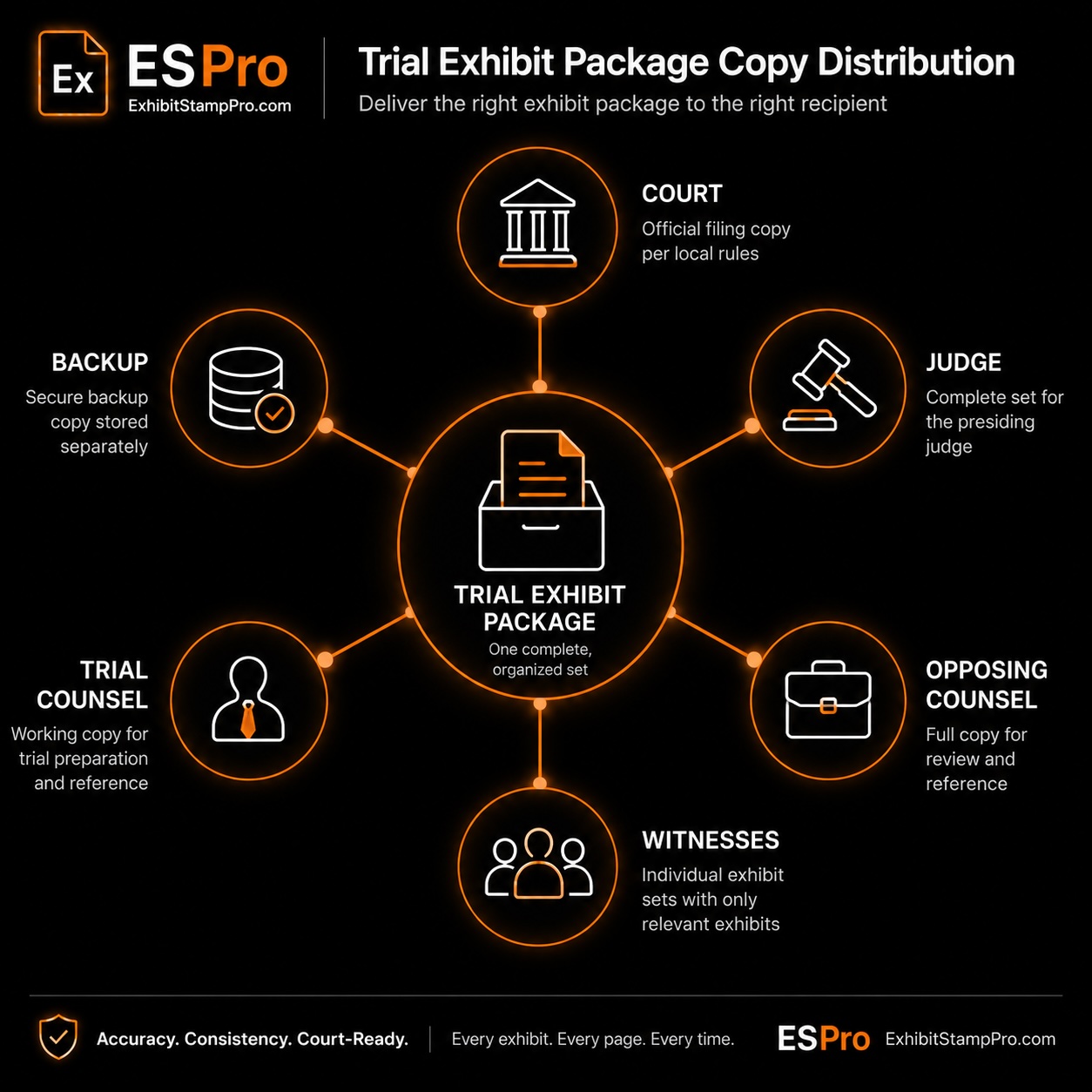
| Recipient | Typical requirement |
|---|---|
| Court filing copy | As required by local rules — often one original set |
| Judge's copy | One complete exhibit package — confirm with court |
| Opposing counsel | One copy per party — confirm exchange requirements |
| Each witness | Individual exhibit set containing only that witness's exhibits |
| Attorney working copy | One annotated copy for trial counsel |
| Backup copy | One complete set secured separately from trial copies |
Attorney review — Phase 2 (final approval)
- Attorney has reviewed the complete exhibit package
- Exhibit order confirmed as final
- Exhibit list reviewed and approved
- All copies reviewed and verified
- Attorney has authorized the package for use at trial
No package should be considered final until this review is complete.
Phase 3 — Trial day
Even after a thorough Phase 2 review, a brief trial-day check prevents overlooked issues from surfacing during proceedings.
- Physical or digital packages are organized and accessible
- Digital backup is available and confirmed functional
- Exhibit list matches the packages in hand
- Judge's copy has been delivered or is ready for delivery
- Witness exhibit sets are available and labeled by witness
- Any last-minute additions have been documented, numbered, stamped, and added to the exhibit list
- Attorney has been briefed on exhibit order and any late changes
Worked example — trial exhibit package
The following example illustrates how a modest trial exhibit package might be organized:
Smith v. Riverside Properties — Trial Exhibit Package
| Exhibit | Description | Witness |
|---|---|---|
| Exhibit 1 | Lease Agreement dated January 15 | All witnesses |
| Exhibit 2 | Property Inspection Report | All witnesses |
| Exhibit 3 | Email dated March 8 (Plaintiff to Defendant) | John Smith |
| Exhibit 4 | Photograph — Unit Condition at Move-Out | All witnesses |
| Exhibit 5 | Repair Invoice #2041 | Karen Reed (Expert) |
Each witness receives only the exhibits relevant to their testimony. The attorney's copy contains all exhibits with working annotations.
Common last-minute problems
The following problems appear most frequently during final pre-trial review. Identifying them before trial — rather than during proceedings — preserves attorney credibility and prevents unnecessary delays.
| Problem | How it typically occurs | Prevention |
|---|---|---|
| Exhibit number mismatch | Exhibit list not updated after late additions | Verify list against packages after every change |
| Missing pages | Scanning error or incomplete export | Review page counts during PDF quality check |
| Unstamped exhibits | Document added after initial stamping | Stamp before assembling final package |
| Wrong orientation | Landscape pages not corrected before export | Review every page during PDF quality check |
| Duplicate numbers | Late document inserted without renumbering | Verify sequence after any addition or removal |
| Missing copies | Copy count not confirmed with attorney | Confirm required copies before assembly begins |
Trial preparation decision table
Use this table as a quick reference when making exhibit package decisions at trial. Confirm with the responsible attorney before finalizing any approach.
| Situation | Recommended approach |
|---|---|
| Exhibit added after package finalized | Assign next available number, stamp, update exhibit list, redistribute affected copies |
| Exhibit removed after numbering | Leave number void or renumber per attorney instruction — document the change |
| Discrepancy between list and package | Halt distribution, reconcile list against packages, confirm with attorney before proceeding |
| Physical binders or electronic packages | Follow attorney preference and court requirements — many courts accept both |
| Witness exhibit sets vs. complete packages | Prepare both — individual witness sets for testimony, complete package for attorney |
| Joint exhibits agreed with opposing counsel | Confirm numbering format and prefix with attorney — often handled under separate designation |
Quality-control checklist
Before the trial exhibit package is considered complete, verify:
- ✅ All documents collected and final versions confirmed
- ✅ Exhibit numbering follows court and attorney requirements
- ✅ No duplicate or missing exhibit numbers
- ✅ Every exhibit stamped with consistent labels
- ✅ All PDFs open correctly and display without errors
- ✅ No pages missing or incorrectly oriented
- ✅ Exhibit order confirmed with attorney
- ✅ Exhibit list matches stamped packages exactly
- ✅ All required copies assembled and labeled
- ✅ Witness exhibit sets prepared and verified
- ✅ Backup copy secured separately
- ✅ Final attorney review completed and approval confirmed
Attorney review recommendations
Attorney review of trial exhibits should occur at two points: during Phase 1 to confirm order and numbering, and during Phase 2 as a final approval before packages are distributed.
Before Phase 2 attorney review, prepare:
- The complete exhibit package in final order
- The exhibit list with all descriptions
- Any witness-specific exhibit sets
- A note of any exhibits that remain pending or unresolved
Changes requested during attorney review — additions, removals, or reordering — require a complete quality-control review before the package is considered final again.
Related resources
- How to Prepare Exhibits for Court — the complete exhibit preparation workflow
- How to Number Court Exhibits — numbering systems, mistakes, and decision guidance
- Complete Guide to Legal Exhibit Preparation — pillar resource for litigation exhibit management
- PDF Exhibit Stamping — apply consistent labels across large trial document sets
- Common Exhibit Preparation Mistakes — prevent errors before they reach the courtroom
Conclusion
A systematic trial exhibit checklist — completed in phases before each proceeding — gives litigation teams confidence that every exhibit is correctly numbered, properly stamped, fully assembled, and accurately reflected on the exhibit list before the first witness is called.
The goal is not to prevent all last-minute changes, which are a practical reality of litigation. The goal is to ensure that planned exhibit preparation is so thorough that last-minute changes are the only source of uncertainty — not avoidable errors discovered during proceedings.
Completing Phase 1 and Phase 2 before the final 24 hours gives the team time to resolve any issues without pressure. The trial-day check is a safety net, not the primary review.
Common questions
When should the trial exhibit checklist be completed?
The bulk of exhibit preparation should be completed at least one week before trial. The final review checklist — covering PDF quality, exhibit list accuracy, and copy distribution — should be completed 24 to 48 hours before trial whenever possible. Last-minute preparation increases the likelihood of errors reaching the courtroom.
How many copies of exhibits are typically needed for trial?
The number of copies depends on local court rules and attorney preference. Common sets include copies for the court, the judge, each witness, and opposing counsel. Confirm the required number with the responsible attorney before assembling packages.
What is a trial exhibit binder?
A trial exhibit binder is a physical or digital collection of all exhibits organized by exhibit number with tabs or dividers for easy reference. Binders are commonly used to help attorneys and witnesses locate exhibits quickly during testimony.
Should exhibits be tabbed in the binder?
Many trial teams use numbered tabs that correspond to exhibit numbers. This allows attorneys, witnesses, and the court to locate exhibits quickly without sorting through loose documents. Confirm the preferred format with the responsible attorney.
What if an exhibit is added the night before trial?
Late exhibit additions require careful handling. The new exhibit must be numbered, stamped, added to the exhibit list, and distributed to all parties in the same format as the rest of the package. This process should be confirmed with the attorney and opposing counsel as required by court rules.